News
From 60Hz to 144Hz: How Does a Display Achieve Ultra-Smooth Motion?
 From 60Hz to 144Hz: How Does a Display Achieve Ultra-Smooth Motion?
DINGTouch Technical Insight: The Evolution of Refresh Rate, Liquid Crystal Response, and High-Performance Touch Displays
In the past, people often debated whether the human eye could truly distinguish frame rates beyond 24 FPS. Today, however, 90Hz, 120Hz, and even 144Hz high refresh rate displays have become essential features in smartphones, gaming monitors, and advanced industrial displays.
When we scroll through a webpage smoothly, operate an HMI interface, or quickly move a crosshair in a competitive game, the “silky smooth” experience comes not only from a higher refresh rate number but from the combined optimization of:
- Liquid crystal materials
- Display driver IC technology
- Response time optimization
- Image processing algorithms
- Power management design
As a professional industrial touch display solution provider, DINGTouch continuously follows the evolution of display technology and provides high-reliability touch display solutions for industrial automation, medical equipment, smart terminals, transportation systems, and other demanding applications.
So, how does an LCD display evolve from a traditional 60Hz panel to a high-performance 120Hz or 144Hz display?

1. What Is Refresh Rate? Understanding the Difference Between 60Hz and 144Hz
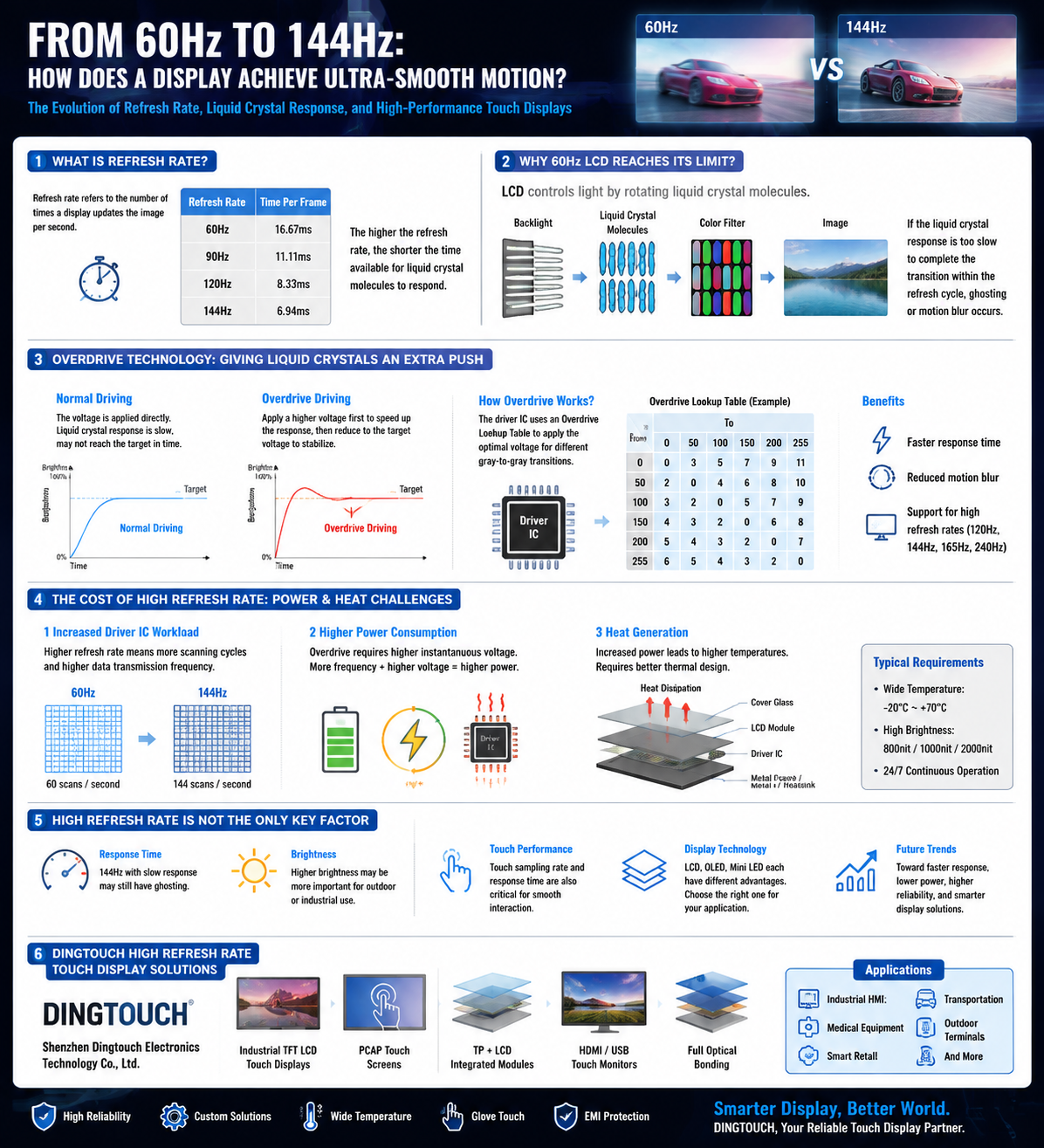
Refresh rate refers to:
The number of times a display updates the image per second.
For example:
- 60Hz: refreshes the image 60 times per second
- 90Hz: refreshes the image 90 times per second
- 120Hz: refreshes the image 120 times per second
- 144Hz: refreshes the image 144 times per second
The refresh cycle is:
| Refresh Rate | Time Available Per Frame |
|---|---|
| 60Hz | 16.67ms |
| 90Hz | 11.11ms |
| 120Hz | 8.33ms |
| 144Hz | 6.94ms |
This means:
A 60Hz LCD gives liquid crystal molecules about 16.67ms to complete a transition, while a 144Hz display allows less than 7ms.
Therefore:
The higher the refresh rate, the shorter the time available for liquid crystal movement.
This creates one of the biggest engineering challenges for high-refresh-rate LCD technology.
2. Why Does a Traditional 60Hz LCD Reach Its Limit?
LCD displays do not generate light by themselves. Instead, they rely on a backlight source and control how much light passes through liquid crystal molecules to create different brightness levels and colors.
A simple explanation:
- Backlight = light source
- Liquid crystal molecules = optical shutters
- Driver IC = control system
When voltage changes, liquid crystal molecules rotate to a new orientation.
This process is called:
Liquid Crystal Response Time
Early LCD technology mainly focused on:
Black-to-White Response Time
This measures:
Black → White → Black
However, real-world images contain far more grayscale transitions:
- Dark gray → light gray
- Blue → purple
- Shadow → highlight
Therefore, modern displays focus more on:
GTG (Gray-to-Gray) Response Time
If liquid crystal response speed cannot keep up with the refresh cycle, the display may suffer from:
- Ghosting
- Motion blur
- Image persistence
For example:
A 144Hz display refreshes every 6.94ms. If the liquid crystal layer has not completed the previous transition, the next frame appears too early, causing visible trailing effects.
3. Overdrive Technology: Giving Liquid Crystals an Extra Push
Since liquid crystal molecules have physical speed limitations, how do engineers make them move faster?
The answer is:
Overdrive Technology
Simply put:
Overdrive applies a temporary higher voltage to accelerate liquid crystal movement.
For example:
Suppose a pixel needs to transition from black to 50% gray.
With normal driving:
The display applies the exact voltage required for 50% gray.
However, the liquid crystal response may be too slow.
With Overdrive:
Step 1:
A higher-than-normal voltage is applied.
This creates a stronger electric field and forces the liquid crystal molecules to rotate faster.
Step 2:
When the target brightness level is reached, the voltage is reduced back to the correct level.
The pixel then stabilizes at the desired gray value.
It is similar to:
A car accelerating strongly at the beginning and then maintaining a steady speed.
How Does Overdrive Achieve Precise Control?
Display driver IC contain:
Overdrive Lookup Tables (LUT)
These tables store optimized voltage compensation values for different grayscale transitions.
For example:
- Black → Gray
- Gray → White
- Blue → Red
Each transition requires different compensation.
Through algorithm optimization:
LCD GTG response time can be reduced from tens of milliseconds to:
1ms or even lower.
This allows modern LCD panels to support:
- 144Hz
- 165Hz
- 240Hz
high refresh rates.
4.High Refresh Rate Is Also a Battle Between Performance and Power Consumption
Many users think:
“Higher refresh rate only makes images smoother.”
In reality, high refresh rate requires:
- More scanning cycles
- Faster data transmission
- Higher driver frequency
- More complex algorithms
1. Increased Driver IC Workload
At 60Hz:
The driver circuit scans the display 60 times per second.
At 144Hz:
It scans 144 times per second.
The driver IC must handle:
- Higher-speed signal transmission
- Faster pixel charging
- More frequent voltage switching
As a result, power consumption increases.
2. Overdrive Requires Additional Energy
To accelerate liquid crystal movement, Overdrive uses higher instantaneous voltages.
Although the high voltage is applied only briefly, repeated operation at high frequency can increase:
- Current consumption
- Heat generation
- Overall power usage
This is why high-refresh-rate devices often require:
- Larger batteries
- Better power management
- More efficient thermal solutions
3. Thermal Challenges in High Refresh Rate Displays
Higher power consumption naturally generates more heat.
The main heat sources include:
- Display driver IC
- Backlight circuits
- High-frequency liquid crystal driving systems
For industrial and medical equipment, reliability is more important than simply achieving a higher refresh rate.
DINGTouch considers:
- LCD power consumption
- Backlight brightness
- Driver IC temperature
- Operating environment
- Long-term stability
For industrial displays, typical requirements include:
- Wide operating temperature: -20°C to +70°C
- High brightness: 800nit, 1000nit, or even 2000nit
- Continuous 24/7 operation capability
A high refresh rate alone is not enough.
5. High Refresh Rate Is Not the Only Important Display Specification
When selecting a display, many users only ask:
“How many Hz does it support?”
However, professional display solutions require a comprehensive evaluation.
1. Response Time
A 144Hz display with slow response speed can still produce motion blur.
2. Brightness
For outdoor industrial applications:
A 60Hz 1000nit display
may provide a better user experience than:
A 144Hz 300nit display.
3. Touch Response Speed
For touch displays, visual refresh rate is only one part of the experience.
Engineers must also consider:
- Touch sampling rate
- Touch response time
- Controller performance
For industrial HMI applications:
Fast display refresh
Fast touch feedback
Stable system response
are all essential.
4. Display Technology Trends
Future display technologies include:
LCD
Advantages:
- Mature technology
- High reliability
- Cost-effective
- Suitable for large sizes
OLED
Advantages:
- Microsecond-level response time
- Self-emissive pixels
- Extremely high contrast ratio
Mini LED
Advantages:
- High brightness
- High dynamic range
- Long service life
Future high-refresh-rate displays will depend not only on refresh frequency but also on:
Material technology + driver algorithms + system engineering
6. DINGTouch High Refresh Rate Touch Display Solutions
With the rapid growth of industrial automation, smart manufacturing, medical devices, and intelligent transportation, display requirements are evolving from:
“Simply displaying information”
to:
“Fast, accurate, and reliable interactive experiences.”
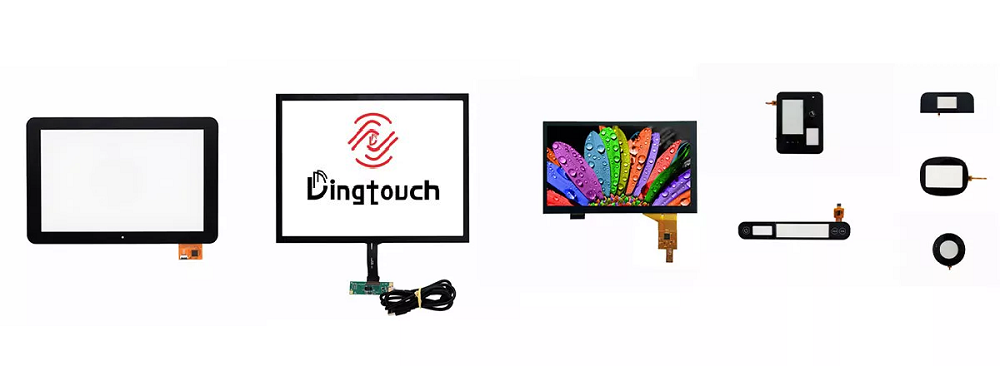
DINGTouch provides:
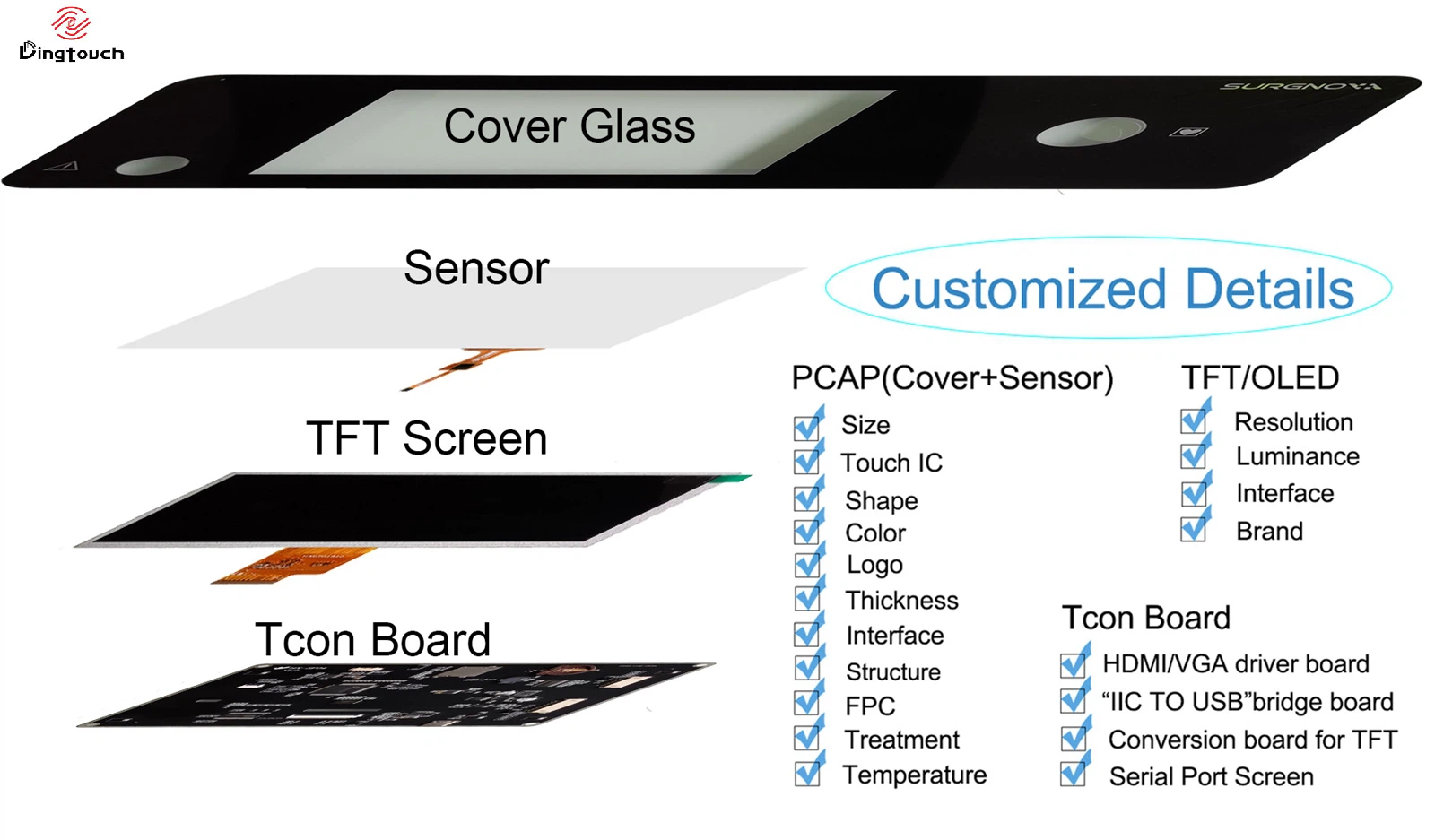
- Industrial TFT LCD touch display solutions
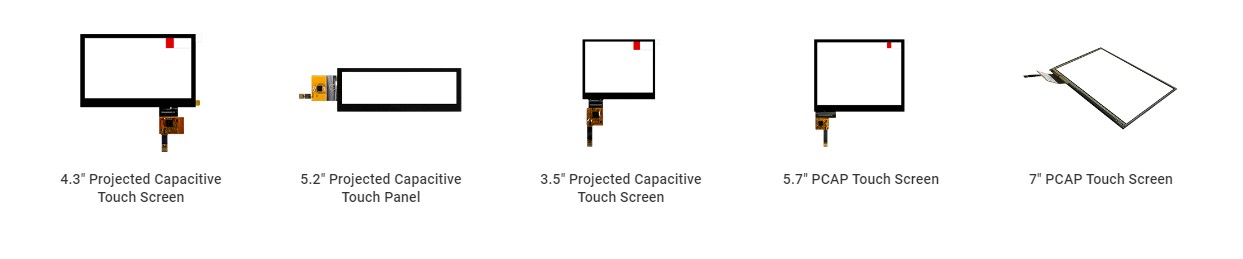
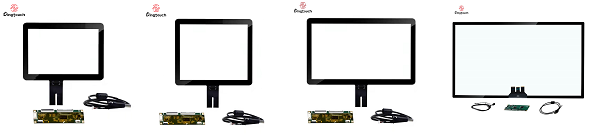
- PCAP capacitive touch screens
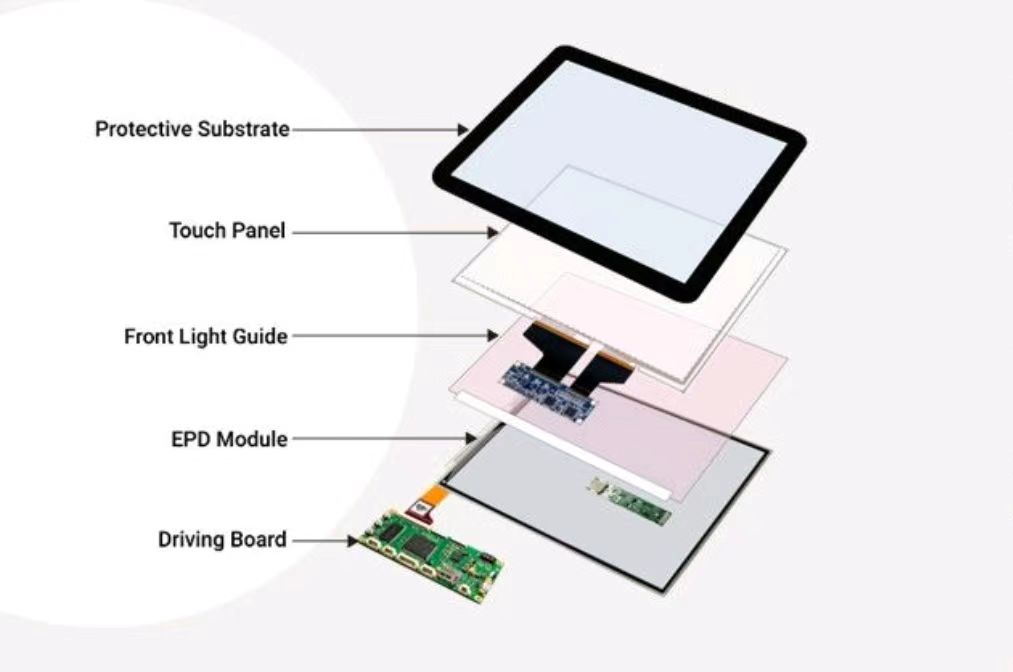
- TP + LCD integrated modules
- HDMI/USB touch monitors
- Full optical bonding solutions
Supporting:
- Custom display sizes
- High brightness solutions
- Wide temperature operation
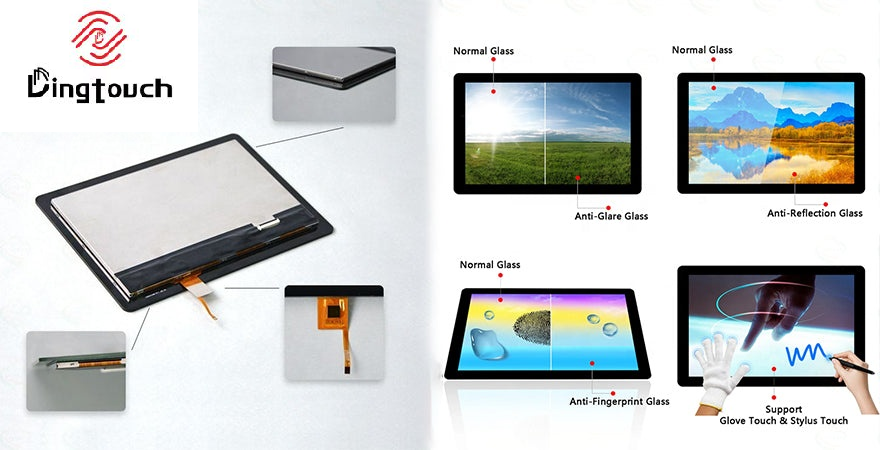
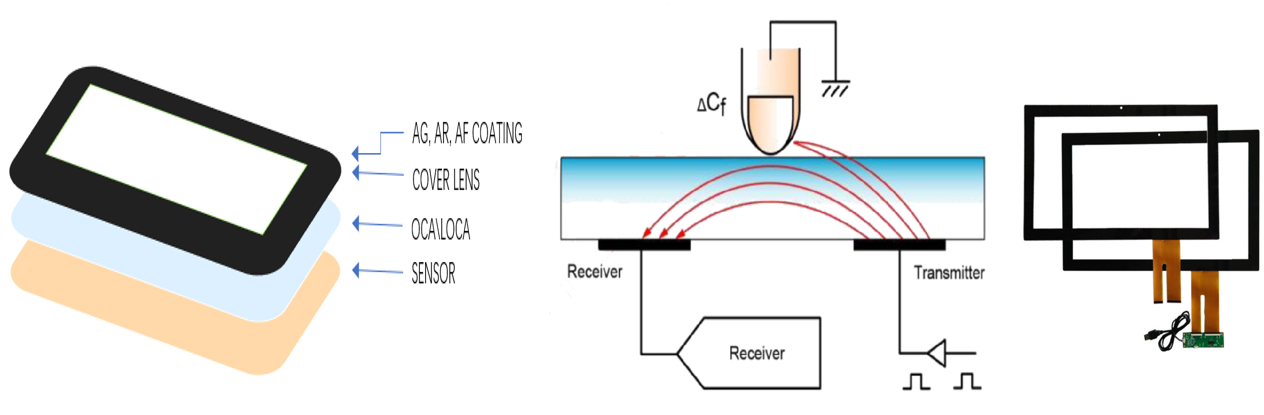
- Anti-glare (AG) coating
- Anti-reflection (AR) coating
- Anti-fingerprint (AF) coating
- Glove touch operation
- EMI-resistant designs
Applications include:
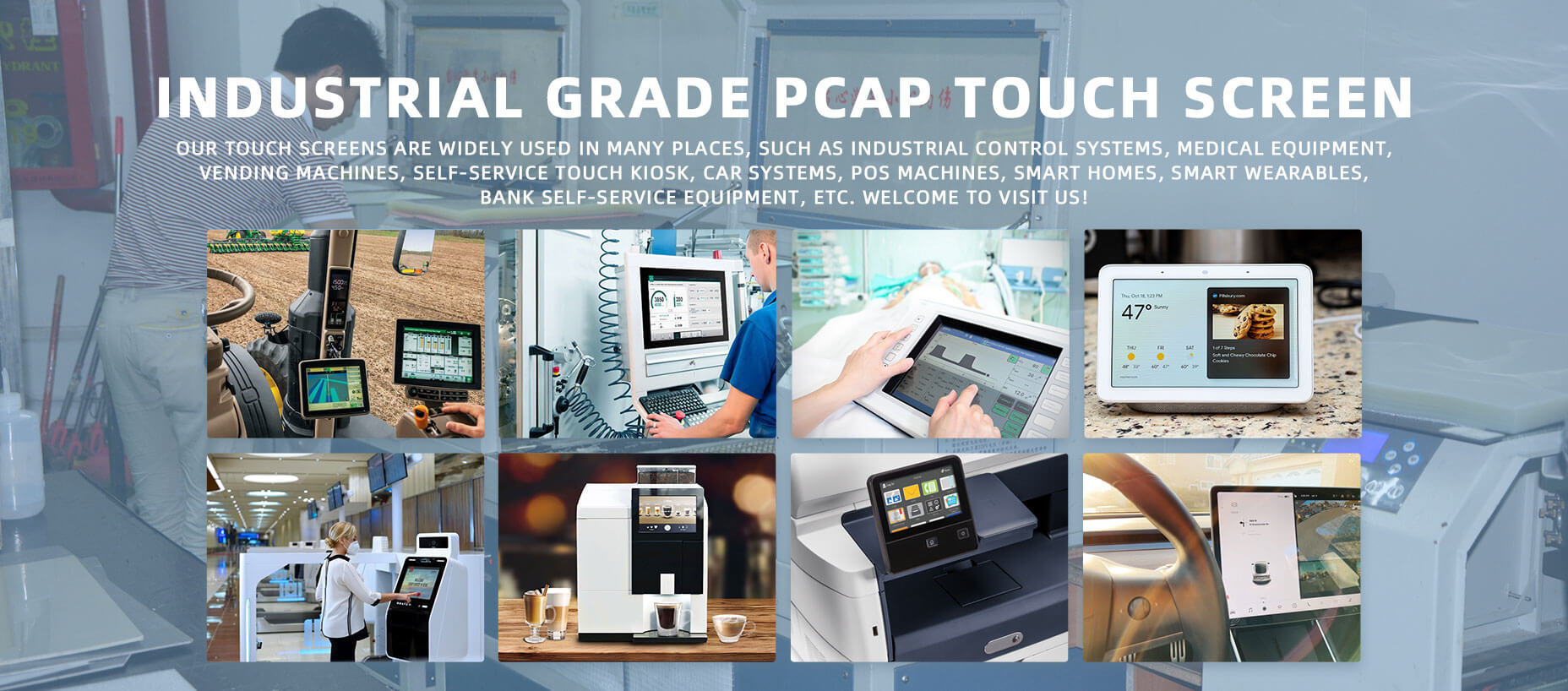
- Industrial HMI
- Medical equipment
- Smart retail terminals
- Transportation systems
- Outdoor interactive devices


Conclusion: From 60Hz to 144Hz — A Revolution in Display Technology
The journey from 60Hz to 144Hz is not simply a numerical upgrade.
It represents breakthroughs in:
- Liquid crystal materials
- Driver algorithms
- IC control technology
- Thermal and power management
Through Overdrive technology, engineers have pushed liquid crystal molecules beyond their natural limitations and opened the door to ultra-smooth visual experiences.
The next time you slide your finger across a touchscreen or operate an industrial control panel, remember:
Behind that smooth response is a highly precise system controlling millions of pixels every second.
With the continued development of OLED, Mini LED, and next-generation display materials, high-refresh-rate displays will continue evolving toward:
Faster response, lower power consumption, and higher reliability.
DINGTouch will continue advancing industrial touch display technology and delivering customized, reliable, and intelligent display solutions for customers worldwide.
Ready to Build Your Outdoor Display Solution?
Get in touch with us at sales@szdingtouch.com. Our expert engineers will help you design a cost-effective, tailored solution to meet your project’s exact specifications.
DINGTouch:Committed to continuous innovation and improvement of product quality to meet customers' high requirements and expectations.
DINGTouch is a manufacturer that provides high quality touch screen panels. Focus on the design, manufacturing and sales of touch screen panels, and are committed to providing customized solutions that satisfy customers.
DINGTouch: In the process of customizing touch screen panels, we focus on close cooperation and communication with customers. Understanding customers' needs and providing customized solutions will meet customers' individual needs. The company's products are favored by customers for their high quality and reliability, and provide them with the best touchscreen panel solutions.
DINGTouch is a company specializing in the R&D and production of touch screen technology, headquartered in Shenzhen, China. As a professional touch screen supplier, DINGTouch is committed to providing high-quality, stable and reliable touch screen products to meet the diverse needs of customers. We continue to carry out technological innovation and product optimization to ensure that its touch screen products have good sensitivity, accuracy and durability.
In addition to the products themselves, we also focus on cooperation and communication with customers, and are committed to providing customized solutions and excellent after-sales services. Through continuous efforts to improve product quality and customer satisfaction, we have established a good reputation in the touchscreen industry and won widespread market recognition.
• PCAP maximum size 65”
• Multi-touch (Touch screen can be customized to your needs.)
• Optical bonding service/air bonding
• LCD interface: HDMI/RGB/MIPI/LVDS/EDP, etc.
• PCAP interface: IIC/USB interface
• CTP can customize the cover glass surface treatment process AG (anti-glare), AR (anti-reflection), AF (anti-fingerprint), waterproof, and glove touch
• Supports 0.55 mm-12 mm coverslip touch.
• Support operating temperature: -40℃-90℃.
In conclusion, Dingtouch as a professional touch screen manufacturer with more than 10 years touch screen experience.We have many capacitive touch screen . Such as 5 inch touch screen,7 inch touch screen,10.1inch touch screen,15 inch touch screen,15.6 inch touch screen,17 inch touch screen,18.5 inch touch screen,19 inch touch screen,21.5 inch touch screen,32 inch touch screen, However, we also welcome to customize your own touch screen . Contact our team today to learn what capacitive touch screen are best for our retail business needs.
Contact us NOW! sales@szdingtouch.com
#Medicaltouchscreencalibration, #capacitivetouchcalibrationguide, #IEC60601touchscreen, #DINGTouchmedicaldisplay, #touchscreenaccuracy, #touchscreen driftfix, #medicalequipmenttouchsolutions, #IP65touchpanel, #IK10medicaltouchscreen, #glove touch medical monitor,#ILITEKTouchControllerICSelectionGuide ,#OCAtoOCR #GT911,#CustomizedWideTemperatureTouchScreenSolutions,#Waterproof Touchscreen,
#highbrightnessLCD, #sunlightreadabledisplay,#industrialLCDbacklight, #outdoor displaymodule, #customLCDsolution, #1000–2000nitsdisplay, #DINGTouchtouchscreen.
#capacitivetouchscreen, #EMI/EMCoptimization, #anti-interferencetechnology, #DINGTouch,#customtouchscreensolutions, #industrialtouchdisplay, #medicaltouch screen, #5Gtouchscreen, #AIanti-interferencealgorithm, #smarttouchdisplay,
DINGTouch — Custom Touch Display Solutions Expert
Every touch, clear and precise, ready for any environment.
DINGTouch delivers more than a screen—we provide end-to-end design, engineering, and customization to help your industrial applications thrive.
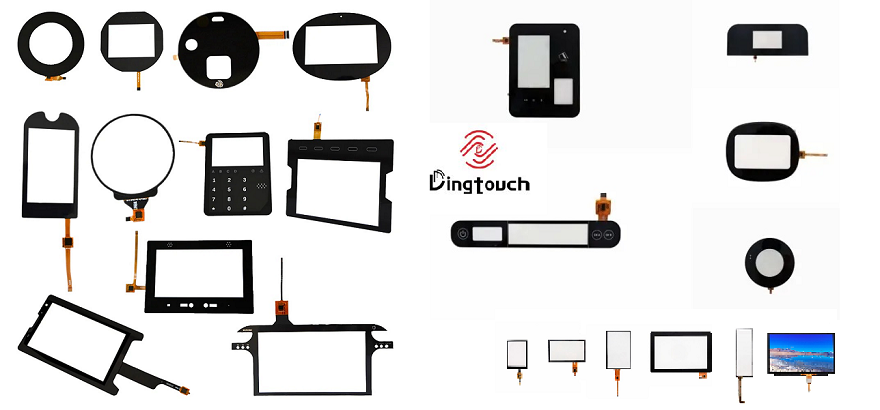




What DINGTOUCH can do:
Dingtouch Industrial capacitive touch screen Manufacturer

CATEGORIES
CONTACT US
Contact: Dingtouch
Phone: +8615815536116
Tel: +8615815536116
Email: sales@szdingtouch.com
Add: Building A, Bailu Plaza, No. 48, Gonghe Industrial Road, Gongle Community, Xixiang Street, Baoan District, Shenzhen,China. 518126
 Dingtouch