News
Wide Temperature Industrial Displays: An Engineering Design Guide for Reliable Operation in Harsh Environments


A Complete Guide to Wide Temperature IPS and TFT Displays, Covering Cold-Temperature Response, High-Temperature Backlight Aging, Condensation, Optical Bonding, Touch Performance, and Environmental Validation
Introduction: Why Wide Temperature Display Design Requires More Than an LCD Specification
Industrial displays used in outdoor terminals, transportation electronics, cold-chain equipment, agricultural machinery, marine systems, and industrial control cabinets must operate reliably under changing environmental conditions.
Unlike consumer electronics, industrial equipment is often exposed to prolonged temperature fluctuations, direct sunlight, moisture, vibration, dust, and demanding operating cycles. In these applications, a display must do more than simply power on. It must maintain readable images, stable electrical performance, accurate touch response, and long-term mechanical reliability.
Selecting a wide temperature IPS or TFT LCD is therefore not simply a matter of comparing the operating temperature ranges listed in different datasheets.
A display module may be rated for a wide temperature range, but its actual performance can change significantly after integration with:
-
A projected capacitive touch panel (PCAP).
-
Chemically strengthened cover glass.
-
OCA or LOCA optical bonding materials.
-
A high-brightness LED backlight.
-
Custom FPC cables and connectors.
-
An enclosure with limited heat dissipation.
-
Sealing materials and mechanical mounting structures.
For example, a display may pass a room-temperature functional test but experience slow image transitions during cold starts, reduced backlight lifetime at elevated temperatures, touch instability caused by condensation, or optical bonding defects after repeated thermal cycling.
At DINGTouch, we approach wide temperature display development as a complete display-system engineering challenge rather than an isolated LCD selection exercise.
With 15 years of industrial touch display customization experience, DINGTouch provides engineering support for LCD, PCAP touch sensors, cover glass, optical bonding, and integrated touch display assemblies.
This guide explains the key technical factors that OEM engineers should evaluate before selecting and approving a wide temperature industrial display.
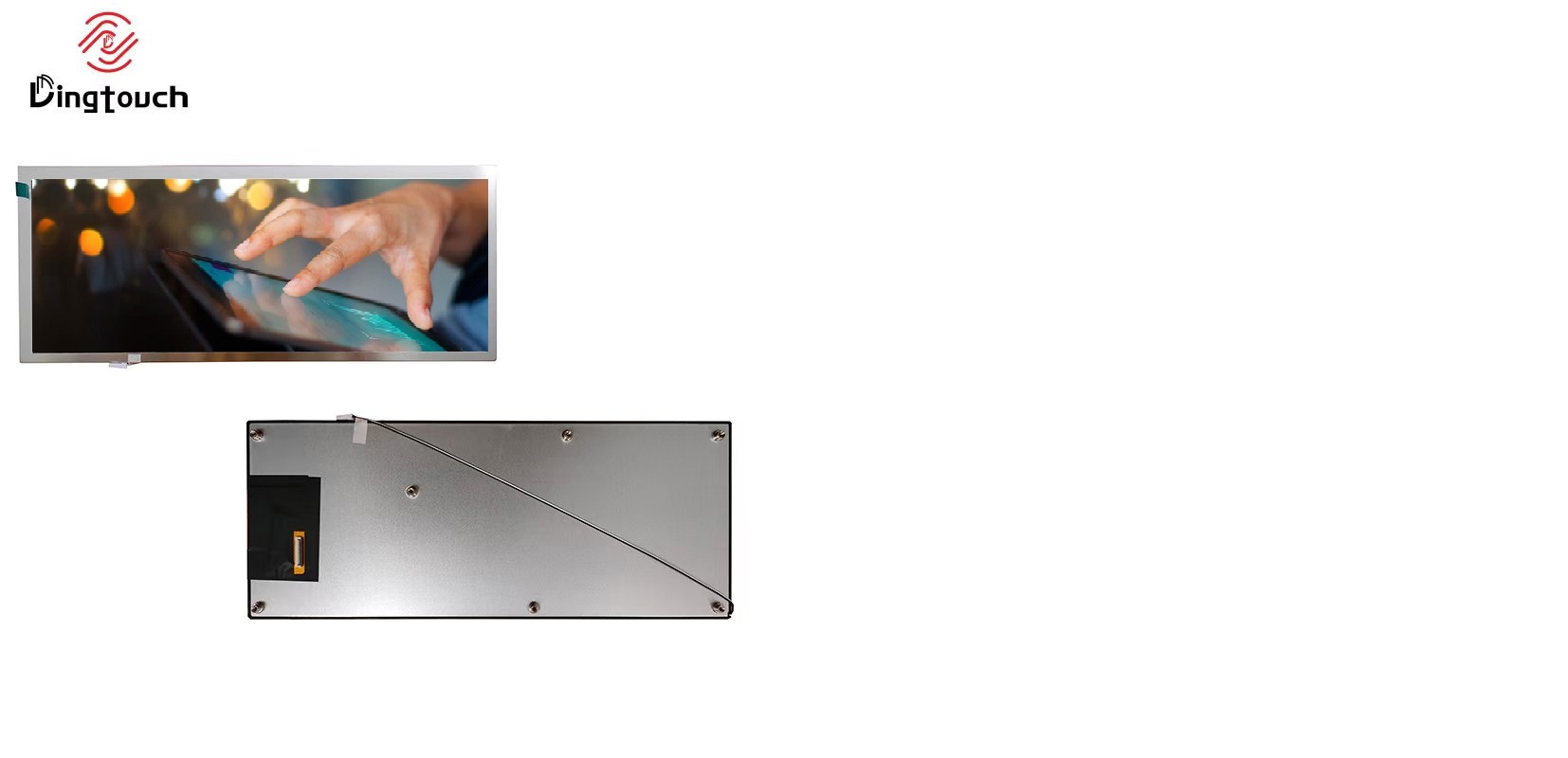
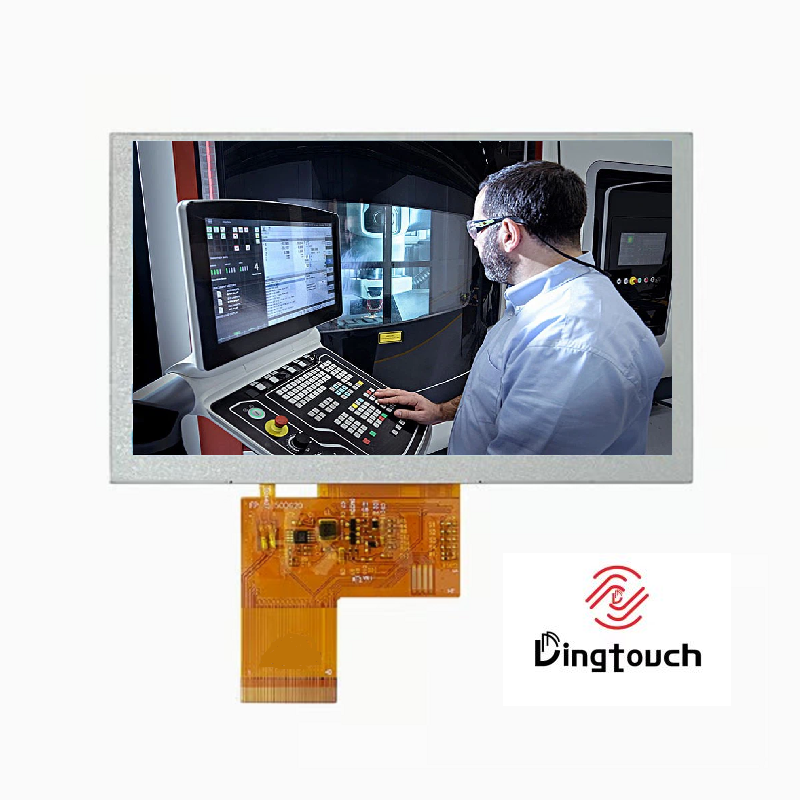

1. Understanding Wide Temperature Display Requirements
Before selecting a display, engineers should distinguish between three important environmental parameters:
-
Operating temperature.
-
Storage temperature.
-
Temperature transition and recovery performance.
These parameters describe different aspects of environmental reliability.
| Parameter | Engineering meaning | What engineers should verify |
|---|---|---|
| Operating temperature | Temperature range in which the display is expected to function | Image quality, touch response, startup and electrical stability |
| Storage temperature | Temperature range the unpowered display can withstand | Material stability, LCD condition and recovery after storage |
| Temperature cycling | Repeated transitions between hot and cold conditions | Bonding integrity, mechanical stress and connection reliability |
| Cold startup | Starting the display at low temperature | Initialization time and image recovery |
| Thermal recovery | Returning to normal operation after temperature exposure | Brightness, contrast and touch performance |
A common mistake is to treat the operating and storage temperature ranges as interchangeable.
For example, a display specified for an operating temperature of -20°C to +70°C and a storage temperature of -30°C to +80°C does not necessarily guarantee normal image performance immediately after being powered on at -20°C.
Similarly, surviving storage at -30°C does not automatically mean the display can operate normally at that temperature.
DINGTouch engineering recommendation: Define the actual operating, storage, cold-start, and recovery requirements separately during the initial project evaluation.
2. Low-Temperature Performance: LCD Response, Cold Startup, and Touch Stability
Low-temperature operation is one of the most important considerations when designing industrial displays for outdoor and cold-chain applications.
2.1 How Low Temperatures Affect IPS and TFT LCD Performance
TFT LCD technology relies on liquid crystal molecules changing their orientation under an applied electric field.
As temperature decreases, liquid crystal viscosity increases, which can slow molecular movement and affect optical response.
Potential symptoms include:
-
Slower image transitions.
-
Motion blur or image ghosting.
-
Delayed response when changing screens.
-
Temporary image abnormalities during cold startup.
-
Longer recovery times after power-on.
The actual behavior depends on the liquid crystal material, panel design, drive conditions, and temperature.
For applications involving moving graphics, real-time monitoring, warning messages, or dynamic instrument readings, engineers should evaluate the display using actual operating content rather than static color patterns alone.
2.2 Cold Startup Requires Separate Validation
A display that operates normally after reaching thermal equilibrium may behave differently when powered on immediately after prolonged exposure to low temperatures.
Engineers should evaluate:
-
LCD initialization at the minimum operating temperature.
-
Backlight startup stability.
-
Image appearance during the first several minutes.
-
Touch controller initialization.
-
Recovery to normal image quality.
-
System behavior during repeated cold-start cycles.
If the application requires immediate visibility after startup, the acceptable startup time should be defined during the product specification stage.
2.3 touchscreen Performance in Cold Environments
Projected capacitive touch technology can also experience environmental challenges.
Although capacitive touch sensors are widely used in industrial applications, their performance depends on the sensor structure, controller configuration, cover glass, grounding, and surrounding electrical environment.
Cold-weather applications may introduce additional factors:
-
Thick protective gloves.
-
Water droplets or condensation.
-
Increased cover glass thickness.
-
Moisture around the sensor edges.
-
Changes in the electrical characteristics of the complete touch assembly.
For applications requiring glove operation, engineers should select an appropriate touch controller and validate sensitivity using the actual cover glass thickness and intended gloves.
DINGTouch can evaluate different PCAP sensor structures and touch controller solutions according to the project requirements.
Important: Glove operation and water rejection should be verified on the final touch assembly rather than assumed from the controller datasheet.
3. High-Temperature Performance: Backlight Aging and Thermal Management
High-temperature operation creates a different set of reliability challenges.
In industrial and outdoor equipment, the internal temperature of the display assembly can be considerably higher than the surrounding ambient temperature.
This is particularly important for equipment installed behind sealed front panels, inside metal enclosures, or under direct sunlight.
3.1 LED Backlight Aging at Elevated Temperatures
LED backlights are sensitive to operating temperature.
Prolonged exposure to excessive heat can accelerate LED degradation and cause gradual brightness reduction.
Other potential problems include:
-
Uneven backlight illumination.
-
Changes in color characteristics.
-
Increased optical aging.
-
Reduced component lifetime.
-
Premature backlight failure.
For high-brightness industrial TFT displays, engineers should evaluate the relationship between brightness, LED driving current, thermal dissipation, and expected operating lifetime.
A 1,000-nit display and a 2,000-nit display do not necessarily have the same thermal requirements, even when they use similar panel dimensions.
3.2 Solar Loading and Enclosure Temperature
Outdoor display design must consider both ambient temperature and solar radiation.
A black front cover can absorb substantial solar energy. When combined with backlight heat and limited enclosure ventilation, this may increase the internal temperature significantly.
The thermal design should therefore consider:
-
Ambient operating temperature.
-
Direct sunlight exposure.
-
Front cover material and color.
-
Backlight power consumption.
-
Enclosure structure.
-
Internal airflow.
-
Heat transfer through the mounting surface.
-
Maximum allowable temperatures of individual components.
3.3 Practical Thermal Management Strategies
Several engineering measures can help improve high-temperature reliability:
Heat dissipation
Use an appropriate metal mounting structure or thermal path to transfer heat away from the display assembly.
Backlight brightness management
Consider adjustable brightness and automatic dimming based on ambient light or internal temperature.
Backlight current optimization
Select a suitable LED driving condition instead of continuously operating the backlight at its maximum rated brightness.
Enclosure design
Evaluate ventilation, heat conduction, and the temperature distribution inside the final housing.
Thermal monitoring
Where necessary, integrate temperature sensors and firmware-based protection strategies.
A high-brightness display should not be approved solely because its datasheet lists a high luminance value. Its thermal performance must also be validated in the intended installation environment.
4. Condensation, Moisture Protection, and Material Compatibility
Condensation is a common but frequently underestimated problem in outdoor and industrial display applications.
It can occur when equipment moves from a cold environment into warm, humid air or experiences rapid temperature changes.
Potential consequences include:
-
Fogging on optical surfaces.
-
Reduced display visibility.
-
Touch detection errors.
-
Moisture penetration into electrical connections.
-
Long-term corrosion.
-
Deterioration of bonding interfaces.
4.1 Why Condensation Occurs
Condensation develops when a surface temperature falls below the dew point of the surrounding air.
For example, equipment removed from a refrigerated warehouse and exposed to warm, humid air may experience condensation on its display cover and other internal or external surfaces.
This means that temperature ratings alone cannot fully describe the moisture resistance of a display system.
Humidity, enclosure sealing, temperature transitions, and installation conditions must also be considered.
4.2 Optical Bonding and Moisture Control
Optical bonding is an important design option for industrial touch displays.
By bonding the cover glass, touch sensor, and LCD into an integrated assembly, manufacturers can reduce internal air gaps and improve optical performance.
Potential benefits include:
-
Reduced internal reflection.
-
Improved sunlight readability.
-
Reduced internal fogging paths.
-
Improved structural integration.
-
Better optical consistency.
However, optical bonding does not automatically make an assembly waterproof or condensation-proof.
The selected OCA or LOCA material must be compatible with the expected temperature range, humidity exposure, ultraviolet radiation, and mechanical stress.
Engineers should also evaluate edge sealing, bonding thickness, surface preparation, and material expansion differences.
4.3 Cover Glass, Adhesives, and Sealing Materials
The reliability of a display assembly depends on the compatibility of its individual materials.
Important materials include:
-
Chemically strengthened cover glass.
-
OCA and LOCA optical adhesives.
-
Touch sensor substrates.
-
LCD polarizers.
-
Peripheral sealing materials.
-
Gaskets and mounting tapes.
Different materials have different coefficients of thermal expansion.
Repeated temperature changes can create mechanical stress at bonding interfaces, potentially resulting in bubbles, edge lifting, delamination, or optical deformation.
For harsh-environment applications, material selection should be based on the complete environmental profile rather than individual component specifications.

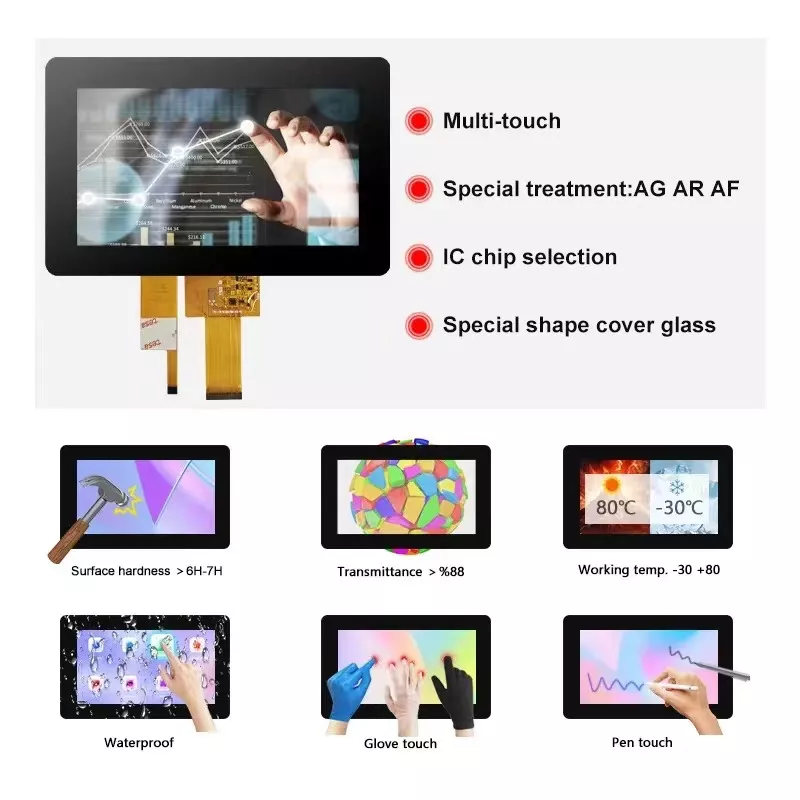
5. Wide Temperature Touch Display Integration: Why the Complete Stack Matters
A wide temperature LCD is only one part of an industrial touch display.
The complete display stack may include:
-
Protective cover glass.
-
Capacitive touch sensor.
-
Optical bonding adhesive.
-
TFT LCD panel.
-
LED backlight.
-
Touch controller and display interface.
-
FPC cables and connectors.
-
Mechanical frame and enclosure.
5.1 Cover Glass Thickness and Touch Sensitivity
Cover glass thickness is an important consideration in rugged industrial touch displays.
Thicker glass can improve mechanical protection, but it also increases the distance between the user's finger and the touch sensor.
This can affect touch sensitivity and controller performance.
For applications requiring IK-rated protection, thick cover glass, or operation with gloves, engineers should evaluate the sensor design and controller settings together.
5.2 Optical Bonding Structure
The choice between air bonding and full optical bonding affects both optical performance and environmental reliability.
Full optical bonding can improve sunlight readability and reduce internal reflections.
However, bonding materials must be selected for the intended operating and storage temperatures.
A bonding solution suitable for an indoor commercial display may not be appropriate for an outdoor industrial application.
5.3 Interface and Electrical Integration
Wide temperature performance is not limited to optical components.
Engineers should also verify:
-
MIPI DSI, LVDS, RGB, or eDP interface compatibility.
-
HDMI or other external display controller requirements.
-
FPC cable and connector temperature ratings.
-
Power supply stability.
-
Backlight driver performance.
-
Touch controller communication.
-
Grounding and shielding.
-
EMI and ESD behavior.
For example, a display may function correctly during a room-temperature test but experience communication instability after cable routing, enclosure installation, or temperature cycling.
The final cable length, connector configuration, grounding arrangement, and host platform should therefore be included in validation.
6. Choosing the Right Wide Temperature Display for Different Industrial Applications
Different applications require different combinations of display performance, environmental protection, and mechanical integration.
| Application | Main environmental challenges | Recommended design considerations |
|---|---|---|
| Outdoor terminals | Sunlight, rain, temperature changes | High brightness, optical bonding, environmental sealing |
| Transportation electronics | Vibration, temperature cycling, electrical interference | Rugged mounting, stable interfaces, thermal validation |
| Cold-chain equipment | Low-temperature startup, condensation | Cold-start validation, suitable LCD materials, moisture management |
| Agricultural machinery | Dust, moisture, vibration, gloves | Rugged cover glass, glove touch, sealing and vibration resistance |
| Industrial control cabinets | Heat accumulation, long operating hours | Thermal management, backlight lifetime, stable interfaces |
| Marine equipment | Humidity, salt exposure, sunlight | Corrosion-resistant structure, sealing, optical readability |
| Medical equipment | Repeated cleaning, long operating cycles, environmental changes | Compatible cover materials, stable touch operation, suitable system validation |
6.1 Outdoor Industrial Displays
Outdoor applications typically require a combination of high brightness, sunlight readability, environmental protection, and thermal management.
Depending on the installation environment, engineers may consider:
-
1,000–2,000 cd/m² or other application-specific brightness levels.
-
IPS TFT LCD technology.
-
Anti-glare (AG) and anti-reflection (AR) treatments.
-
Chemically strengthened cover glass.
-
Full optical bonding.
-
Waterproof and dust-resistant mechanical structures.
The required brightness should be determined by ambient light conditions, optical transmission, viewing angle, and thermal constraints.
Higher brightness is not automatically better if the enclosure cannot dissipate the additional heat.
6.2 Cold-Chain and Refrigeration Equipment
Cold-chain terminals and refrigeration control systems need reliable startup and readable information under low-temperature conditions.
Important validation items include:
-
Minimum operating temperature.
-
Cold-start time.
-
Image response and recovery.
-
Touch operation with gloves.
-
Condensation during temperature transitions.
-
Cable and connector reliability.
The final display should be tested inside the intended enclosure whenever possible.
6.3 Agricultural and Construction Machinery
Agricultural machinery and construction equipment can experience vibration, dust, moisture, direct sunlight, and operation by users wearing protective gloves.
For these applications, the display design should consider both environmental protection and physical durability.
A suitable solution may combine a rugged cover lens, PCAP touch technology, optical bonding, a high-brightness TFT LCD, and a mechanically reinforced structure.
7. Environmental Validation: How to Test a Complete Wide Temperature Display
A reliable validation program should use the final integrated display assembly, not simply an open-frame LCD sample on a laboratory bench.
The test sample should represent the expected production configuration, including:
-
LCD panel and backlight.
-
Touch sensor.
-
Cover glass.
-
OCA or LOCA bonding.
-
FPC cables and connectors.
-
Backlight driver.
-
Mechanical frame.
-
Sealing materials.
-
Enclosure.
-
Production-intent firmware.
7.1 Recommended Environmental Validation Items
| Test item | What to evaluate |
|---|---|
| Low-temperature operation | Image response, touch sensitivity and startup |
| High-temperature operation | Backlight stability, image quality and component temperatures |
| Storage temperature | Material condition and recovery after exposure |
| Thermal cycling | Bonding integrity and mechanical stress |
| Humidity exposure | Moisture resistance and electrical stability |
| Condensation assessment | Optical clarity and touch behavior |
| Vibration testing | Connectors, mounting structure and assembly integrity |
| ESD testing | Touch controller and system stability |
| EMI testing | Display signal integrity and touch interference |
| Power cycling | Initialization and repeated startup reliability |
| Long-duration operation | Brightness stability and abnormal image behavior |
The exact test conditions, temperature limits, exposure duration, and acceptance criteria should be established according to the final product specification and applicable industry requirements.
7.2 Test Real Operating Conditions
Environmental testing should reproduce the actual usage scenario as closely as possible.
For optical performance, use the expected ambient lighting conditions and actual user interface content.
For electrical performance, use production-intent cables, connectors, power supplies, and grounding arrangements.
For mechanical performance, verify mounting tolerances, enclosure deformation, and assembly repeatability.
For software performance, check startup sequences, brightness adjustment, screen orientation, touch calibration, sleep, wake-up, and error recovery.
A display that passes a short laboratory test may still fail after installation inside a sealed enclosure or during extended full-brightness operation.
Engineering principle: Validate the complete display system under realistic operating conditions, not just the LCD panel under isolated laboratory conditions.
8. Procurement and Product Lifecycle: Questions OEM Buyers Should Ask Display Suppliers
For industrial products expected to remain in production for many years, display selection must include supply-chain and lifecycle considerations.
A technically suitable display can still become a project risk if its key components are discontinued or frequently changed.
OEM engineering and procurement teams should request the following information from their display suppliers:
Technical documentation
-
LCD datasheet and mechanical drawings.
-
Display interface specifications and timing information.
-
Backlight electrical characteristics.
-
Touch controller specifications.
-
Cover glass and optical bonding details.
-
Operating and storage temperature ratings.
Reliability and compliance information
-
Available environmental test reports.
-
Optical and brightness test methods.
-
Relevant material specifications.
-
RoHS and REACH compliance information, where required.
-
Applicable quality and manufacturing documentation.
Supply-chain information
-
Expected product lifecycle.
-
Component change notification procedures.
-
Availability of alternative LCD panels.
-
Touch controller and driver IC sourcing stability.
-
Long-term production and service support.
8.1 Why Alternative Display Solutions Should Be Evaluated Early
For customized industrial equipment, the display may become a critical component of the entire product architecture.
If a specific LCD panel becomes unavailable, replacing it with another model may affect:
-
Mechanical dimensions.
-
Active display area.
-
Connector position.
-
Interface timing.
-
Backlight power consumption.
-
Touch sensor alignment.
-
Firmware compatibility.
Evaluating potential alternatives during the initial development stage can reduce future redesign costs.
DINGTouch recommends considering mechanical compatibility, electrical flexibility, and component availability as part of the initial display project review.
9. Engineering Checklist Before Approving a Wide Temperature Display
Before approving a wide temperature industrial touch display, engineering teams should review the following items.
Temperature and performance
-
Operating and storage temperatures are clearly defined.
-
Cold-start and recovery performance are verified.
-
High-temperature image and backlight performance are evaluated.
-
Thermal cycling is performed on the complete assembly.
Optical and mechanical structure
-
Cover glass thickness and material are confirmed.
-
Optical bonding adhesive is suitable for the intended environment.
-
Thermal expansion differences are evaluated.
-
Sealing and enclosure structures are validated.
Touch and electrical integration
-
Touch sensitivity is tested with the actual cover glass.
-
Glove and water operation are evaluated where required.
-
Interface compatibility is confirmed.
-
Cables, connectors, grounding, and shielding are tested.
Reliability and supply chain
-
Environmental validation criteria are documented.
-
Production-intent components are used during testing.
-
Component lifecycle and change management are reviewed.
-
Alternative solutions are evaluated where necessary.
10. How DINGTouch Supports Custom Wide Temperature Industrial Display Projects
Selecting a wide temperature display is a system-level engineering decision.
The LCD panel, touch sensor, cover glass, optical adhesive, backlight, electrical interface, and mechanical structure must work together under the actual operating conditions.
DINGTouch specializes in customized industrial touch display solutions, supporting OEM and equipment manufacturers from initial technical evaluation through sample development and production.
Our engineering and manufacturing capabilities cover:
-
Industrial TFT LCD: IPS and TFT display solutions for industrial applications.
-
PCAP Touch Technology: Customized capacitive touch sensors with controller and interface options.
-
Cover Glass Customization: Chemically strengthened glass, customized dimensions, thickness, black borders, and AG/AR/AF surface treatments.
-
Optical Bonding: Integrated display assemblies using suitable OCA or LOCA bonding processes.
-
High-Brightness Solutions: Display configurations for outdoor and high-ambient-light environments.
-
Rugged Display Integration: Customized structures for applications requiring environmental protection and mechanical durability.
-
Interface Customization: MIPI, LVDS, RGB, eDP, HDMI, USB, I2C, and other project-dependent configurations.
We evaluate each project according to its actual requirements, including operating temperature, storage conditions, brightness, touch behavior, installation dimensions, interface compatibility, and expected service life.
Our objective is not simply to supply an LCD with a wide temperature rating. It is to help customers develop an integrated industrial touch display that remains reliable in its intended application.
For OEM projects requiring customized industrial display solutions, DINGTouch provides one-to-one engineering support, project evaluation, and customized display development.
DINGTouch – Industrial Touch Display Manufacturer | Custom LCD, PCAP Touch, Cover Glass and Optical Bonding Solutions
Website: https://www.szdingtouch.com
Frequently Asked Questions About Wide Temperature Industrial Displays
Q1. What is considered a wide temperature industrial display?
A wide temperature industrial display is designed to operate across a broader temperature range than conventional commercial displays.
The actual temperature rating varies by product. Common industrial requirements include -20°C to +70°C, -30°C to +80°C, or other application-specific ranges.
The complete display assembly must be evaluated rather than relying only on the LCD panel rating.
Q2. Can an IPS display operate at -30°C?
Some IPS TFT LCD solutions can be designed for low-temperature industrial applications. However, actual performance depends on the liquid crystal material, panel construction, drive conditions, and backlight design.
Cold-start time, image response, and recovery performance should be verified at the required temperature.
Q3. Does high brightness reduce the lifetime of an industrial display?
High brightness can increase LED backlight power consumption and thermal load.
If the backlight operates continuously at high output without adequate heat dissipation, LED aging may accelerate.
Appropriate thermal management and brightness control can help improve long-term reliability.
Q4. Is optical bonding necessary for outdoor industrial displays?
Optical bonding is not mandatory for every outdoor display, but it can improve optical performance by reducing internal reflections and improving sunlight readability.
It can also reduce internal air gaps that may contribute to fogging.
The bonding material and edge structure must be selected according to the actual temperature and environmental requirements.
Q5. Can a capacitive touchscreen work with gloves in cold environments?
Yes, appropriately designed PCAP touch solutions can support glove operation.
However, performance depends on the touch controller, sensor structure, cover glass thickness, glove material, grounding, and environmental conditions.
The complete touch assembly should be tested with the actual gloves used by operators.
Q6. What is the difference between operating temperature and storage temperature?
Operating temperature refers to the temperature range in which the display is expected to function.
Storage temperature refers to the temperature range the unpowered display can withstand without unacceptable degradation.
A display that survives a low-temperature storage test does not necessarily guarantee immediate normal operation at that same temperature.
Q7. How should OEM engineers validate a wide temperature display?
OEM engineers should test the complete production-intent display assembly under the expected environmental conditions.
Testing should include cold startup, high-temperature operation, thermal cycling, humidity, condensation assessment, touch response, electrical st
CATEGORIES
CONTACT US
Contact: Dingtouch
Phone: +8615815536116
Tel: +8615815536116
Email: sales@szdingtouch.com
Add: Building A, Bailu Plaza, No. 48, Gonghe Industrial Road, Gongle Community, Xixiang Street, Baoan District, Shenzhen,China. 518126
 Dingtouch