News
Electronic Skin (E-Skin) & FSR Sensor Manufacturer | Custom Flexible Pressure Sensor Solutions
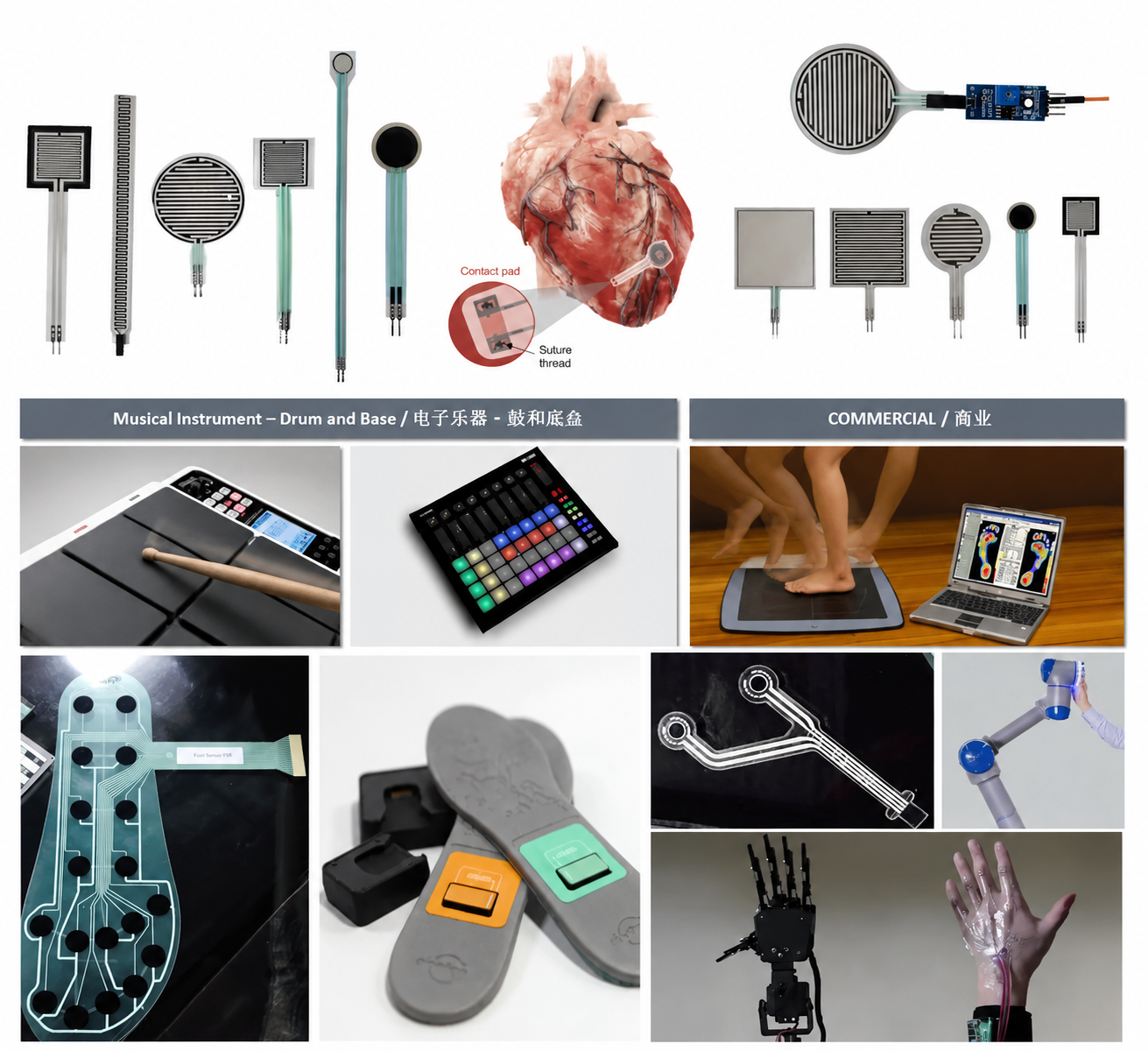 Electronic Skin (E-Skin) & FSR Sensor Manufacturer | Custom Flexible Pressure Sensor Solutions
Flexible Pressure Sensing Technology for Robotics, Medical Devices, Industrial Automation and Intelligent Human-Machine Interfaces
Looking for a reliable Electronic Skin (E-Skin) and FSR sensor manufacturer? DINGTouch provides custom flexible pressure sensors, tactile sensing solutions, OEM/ODM development, and complete touch display integration for robotics, medical devices, automotive electronics, industrial automation, and wearable applications.
Custom Electronic Skin (E-Skin) & FSR Sensor Solutions
As robotics, artificial intelligence, smart healthcare, and intelligent automation continue to evolve, the demand for flexible sensing technologies is growing rapidly. Modern devices are expected to do far more than simply display information—they must perceive touch, pressure, force, and human interaction in real time. This has made Electronic Skin (E-Skin) and Force Sensitive Resistor (FSR) technologies essential components in next-generation Human-Machine Interface (HMI) systems.
At DINGTouch, we believe intelligent products require more than individual components. They require complete, integrated solutions that combine sensing, touch control, display technology, and reliable manufacturing.
Building on more than 14 years of experience in capacitive touch screens, TFT LCD display modules, cover glass manufacturing, and optical bonding technology, DINGTouch has expanded its capabilities to include custom Electronic Skin and FSR sensor development. Our engineering team provides OEM and ODM services from concept design and prototype development to volume production, helping customers accelerate product development while reducing supply chain complexity.
Unlike suppliers that only manufacture sensors or only provide displays, DINGTouch delivers a complete HMI solution by integrating flexible pressure sensors with touch panels, TFT LCD displays, custom cover glass, optical bonding, FPC design, and embedded interface solutions.
Whether you are developing a humanoid robot, a medical diagnostic device, an intelligent vehicle control system, a smart wearable product, or an industrial automation terminal, DINGTouch is ready to support your project with reliable engineering, rapid prototyping, and scalable manufacturing.
What Can DINGTouch Provide?
DINGTouch offers comprehensive customization services for flexible sensing and display technologies. Our goal is to help customers simplify product development by working with one trusted manufacturing partner.
Our capabilities include:
- Custom Electronic Skin (E-Skin) design
- Force Sensitive Resistor (FSR) sensor development
- Flexible pressure sensing films
- Printed force sensing technology
- Capacitive touch panels (PCAP)
- TFT LCD display modules
- Optical bonding (OCA)
- AG, AR and AF cover glass surface treatments
- Flexible Printed Circuit (FPC) design
- USB, I²C, SPI and UART interface integration
- Controller selection and firmware support
- Rapid prototype development
- Small-batch pilot production
- Stable mass production
- Mechanical and electrical integration support
With these capabilities, customers can source complete Human-Machine Interface components from a single supplier, reducing communication costs and shortening development cycles.
What Is Electronic Skin (E-Skin)?
Electronic Skin, often referred to as E-Skin, is a flexible sensing technology designed to imitate the perception capabilities of human skin. It can detect pressure, touch, deformation, bending, and other external stimuli, converting physical interaction into electrical signals that can be processed by intelligent control systems.
Unlike conventional rigid sensors, Electronic Skin is manufactured on flexible substrates such as PET or polyimide (PI), allowing it to conform to curved or irregular surfaces while maintaining excellent sensing performance. This flexibility makes it particularly suitable for applications where traditional sensors cannot be easily integrated.
Electronic Skin enables machines to perceive their surroundings in a way that is closer to human touch, improving safety, interaction accuracy, and operational intelligence.
Typical applications include:
- Humanoid robots
- Collaborative robots (Cobots)
- Medical monitoring equipment
- Rehabilitation devices
- Prosthetic systems
- Smart wearable electronics
- Automotive interiors
- Intelligent control panels
- Smart home products
- Interactive consumer electronics
As artificial intelligence continues to advance, Electronic Skin is becoming a key enabling technology for creating more responsive and adaptive intelligent systems.
What Is a Force Sensitive Resistor (FSR) Sensor?
A Force Sensitive Resistor (FSR) is a flexible pressure sensor whose electrical resistance changes according to the force applied to its sensing surface. By measuring these resistance variations, the system can accurately detect pressure, touch, weight, or contact events.
Compared with conventional mechanical switches, FSR sensors provide several significant advantages:
- Ultra-thin structure
- Lightweight design
- Excellent flexibility
- Fast response speed
- Long operating life
- Low power consumption
- Easy integration into compact devices
- Customizable sensing areas
- Reliable performance in demanding environments
Depending on system requirements, FSR sensors can be designed to detect:
- Finger touch
- Grip force
- Pressure distribution
- Object presence
- Weight measurement
- Collision detection
- Human interaction
- Smart button activation
At DINGTouch, our engineering team customizes each FSR sensor according to customer requirements, including sensing area, pressure sensitivity, substrate material, connector type, output interface, mechanical dimensions, and environmental performance.
Why Integrate Electronic Skin with Touch Displays?
Many manufacturers specialize in either flexible sensors or display modules. However, intelligent devices increasingly require these technologies to operate as a unified system.
For example, a humanoid robot may need to display visual information, detect user touch, measure grip force, and provide intelligent feedback simultaneously. Procuring these components from multiple suppliers often increases development complexity, compatibility issues, and project timelines.
DINGTouch simplifies this process by providing an integrated solution that combines:
- Electronic Skin (E-Skin)
- Flexible FSR Sensors
- Capacitive Touch Screens
- TFT LCD Display Modules
- Cover Glass
- Optical Bonding
- Flexible Printed Circuits
- Embedded Interface Design
This one-stop approach offers several benefits:
- Faster product development
- Simplified supply chain management
- Improved compatibility between components
- Higher system reliability
- Reduced engineering costs
- Consistent product quality
- Faster time-to-market
Rather than purchasing individual components from multiple vendors, customers can work directly with DINGTouch to develop a complete Human-Machine Interface solution tailored to their application.
Key Features of DINGTouch Electronic Skin Solutions
Our Electronic Skin and FSR sensor solutions are designed to meet the demanding requirements of industrial, medical, robotic, and automotive applications.
Key features include:
- Ultra-thin flexible construction
- High transparency options
- Excellent bending resistance
- High sensitivity and fast response
- Stable long-term performance
- Low power consumption
- Custom sensor geometry
- Flexible PET or PI substrates
- Waterproof design options
- EMI shielding solutions
- Wide operating temperature customization
- High reliability for continuous operation
- OEM and ODM development support
By combining flexible sensing technology with DINGTouch expertise in touch displays and optical integration, customers gain access to a complete, scalable platform for developing next-generation intelligent devices.
How Electronic Skin Works & Applications
How Electronic Skin (E-Skin) Works
Electronic Skin works by converting mechanical pressure or deformation into measurable electrical signals through flexible sensing layers.
Although different structures may be used depending on application requirements, most E-Skin systems follow a similar working principle:
- External force is applied to the surface
- Flexible conductive or resistive layers deform
- Electrical resistance or capacitance changes
- Signal is collected by electrodes
- Controller processes the signal
- Data is transmitted to system (robot, display, MCU, AI system)
This structure allows Electronic Skin to simulate the way human skin senses pressure and touch.
Unlike traditional rigid sensors, E-Skin can cover large and curved surfaces, making it ideal for robotic hands, wearable devices, and smart surfaces.
FSR Sensor Working Principle
A Force Sensitive Resistor (FSR) operates based on resistance variation.
When pressure is applied:
- Conductive particles inside the sensor layer become more densely packed
- Electrical resistance decreases
- The controller measures this change
- Pressure intensity is calculated
FSR sensors are widely used because of their simplicity, durability, and low cost.
They are especially suitable for:
- Pressure detection
- Force feedback systems
- Touch sensing interfaces
- Human interaction systems
Electronic Skin vs FSR Sensor
Although Electronic Skin and FSR sensors are often used together, they are not identical technologies.
| Feature | Electronic Skin (E-Skin) | FSR Sensor |
|---|---|---|
| Function | Multi-point sensing surface | Point or zone pressure detection |
| Structure | Flexible multi-layer film | Resistive pressure layer |
| Coverage | Large-area sensing | Localized sensing |
| Complexity | Higher | Lower |
| Data Output | Multi-channel | Single or limited channels |
| Application | Robots, AI systems, wearables | Buttons, pressure pads, simple sensing |
| Flexibility | Very high | High |
In modern intelligent systems, both technologies are often combined to achieve better interaction performance.
Why Flexible Sensors Are Critical for Robotics
Robotics is one of the fastest-growing application areas for Electronic Skin and FSR sensors.
Modern humanoid robots require:
- Human-like touch perception
- Safe human-robot interaction
- Grip force control
- Collision detection
- Object recognition through touch
Without flexible sensors, robots rely only on vision systems, which are not sufficient for fine physical interaction.
Electronic Skin enables robots to:
- Feel pressure distribution across fingers
- Detect subtle contact changes
- Improve grip accuracy
- Prevent excessive force damage
- Enhance AI learning feedback
Medical Applications
In the medical field, Electronic Skin and FSR sensors are widely used for patient monitoring and rehabilitation systems.
Typical applications include:
- Pressure monitoring in hospital beds
- Bed sore prevention systems
- Rehabilitation equipment feedback
- Prosthetic limb control
- Medical wearable devices
- Patient posture monitoring
These applications require high reliability, comfort, and continuous monitoring capability.
Flexible sensors are ideal because they can be integrated into soft surfaces and wearable systems without affecting patient comfort.
Automotive Applications
In automotive systems, pressure sensing technology is becoming increasingly important for safety and intelligent interaction.
Applications include:
- Seat occupancy detection
- Driver monitoring systems
- Steering wheel grip detection
- Interior touch interaction systems
- Smart seat pressure distribution analysis
By integrating Electronic Skin into vehicle interiors, automotive systems can better understand driver behavior and improve safety systems.
Industrial Automation Applications
Industrial environments require durable and reliable sensing systems.
Electronic Skin and FSR sensors are used for:
- Machine safety detection systems
- Human-machine interaction panels
- Pressure-sensitive control interfaces
- Industrial robot collision detection
- Smart production line monitoring
These systems improve safety and efficiency in automated production environments.
Smart Wearables & IoT Applications
Flexible sensors are widely used in wearable devices due to their thin and lightweight structure.
Common applications include:
- Smart insoles
- Fitness monitoring systems
- Gesture recognition gloves
- Health tracking devices
- Smart textiles
These devices rely on accurate pressure and motion detection to provide real-time feedback.
Product Application Overview (Visual Reference)
Below is a visual overview of typical application scenarios for Electronic Skin and FSR sensor technologies:
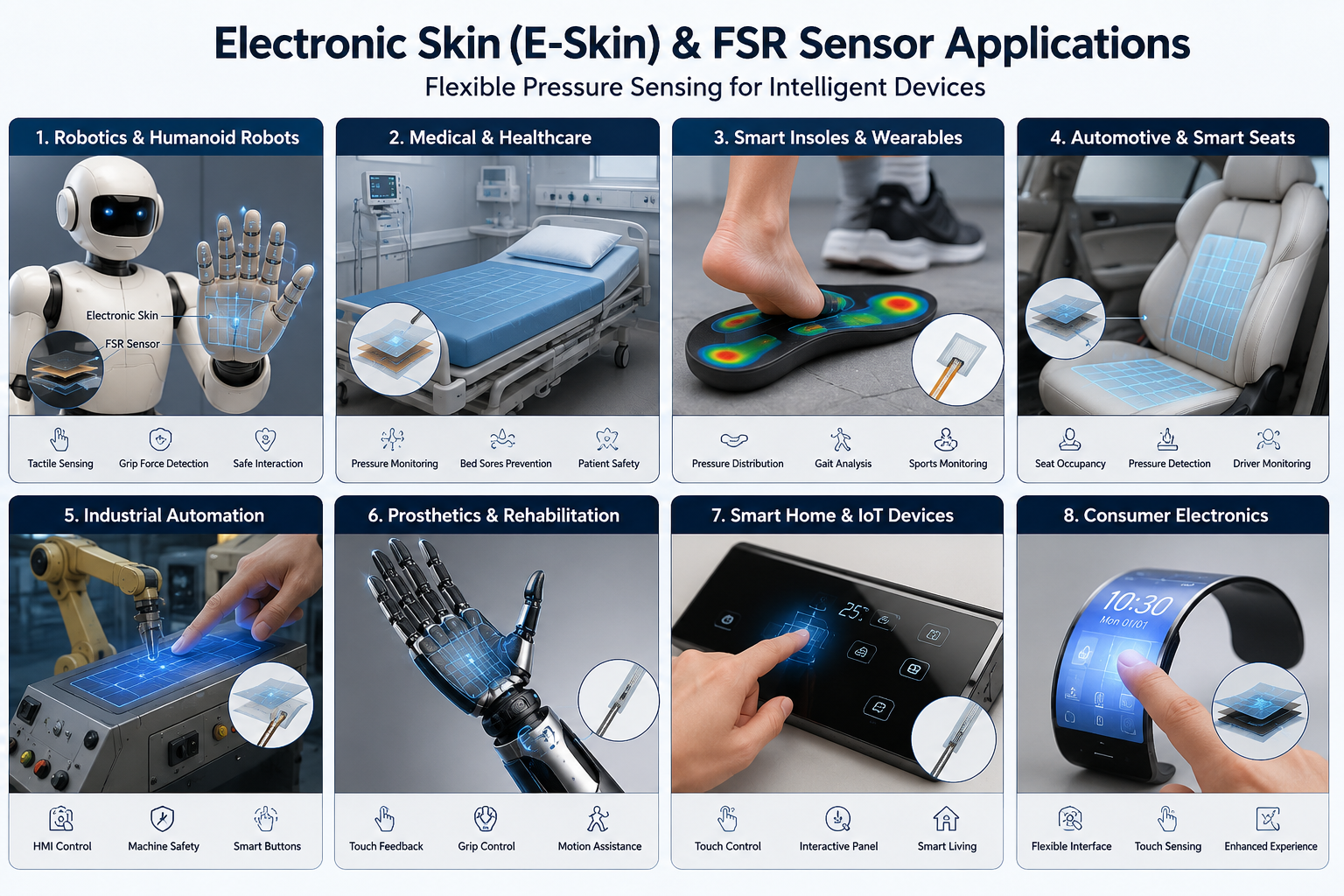
These applications demonstrate how flexible sensing technology is transforming robotics, healthcare, automotive systems, and intelligent human-machine interfaces.
Why These Applications Matter for Future AI Systems
As AI systems become more advanced, visual data alone is not enough.
Machines must also develop physical perception ability, including:
- Touch
- Pressure
- Force feedback
- Surface interaction
Electronic Skin and FSR sensors provide this missing sensory layer, enabling machines to interact more naturally with humans and their environment.
This is why flexible sensing technology is expected to play a key role in:
- Humanoid robotics
- AI-driven automation
- Smart healthcare systems
- Next-generation industrial HMI
Why Choose DINGTouch? Custom E-Skin Manufacturing & One-Stop Flexible Pressure Sensor Solutions
As flexible pressure sensing technology continues to expand into robotics, medical electronics, smart wearables, and industrial automation, selecting the right manufacturing partner becomes just as important as selecting the sensor technology itself.
A successful electronic skin (E-Skin) project requires much more than sensor fabrication. It demands expertise in material science, flexible electronics, optical bonding, embedded hardware integration, firmware optimization, and scalable manufacturing.
At DINGTouch, we provide complete custom flexible sensing solutions—from concept design and rapid prototyping to mass production and long-term supply support.
Whether you need a single force sensing layer or a fully integrated HMI module, our engineering team helps reduce development risks while accelerating your product launch.
Complete Customization for Electronic Skin Applications
Every E-Skin project has unique requirements.
Unlike standardized sensors, flexible pressure sensors are typically customized according to application environment, mechanical structure, sensitivity requirements, and integration methods.
DINGTouch offers complete OEM/ODM customization services including:
Sensor Size & Shape
Custom dimensions from miniature wearable sensors to large-area pressure mapping systems.
Options include:
- Square
- Circular
- Curved
- Flexible strip
- Ring-shaped
- Irregular geometry
Custom cutouts and mounting holes are also available.
Pressure Range Customization
Different industries require different sensing ranges.
We optimize sensor materials and conductive structures for:
- Ultra-light touch detection
- Human touch sensing
- Medical pressure monitoring
- Industrial force measurement
- Heavy-load pressure sensing
Typical force ranges:
- 10 g
- 50 g
- 100 g
- 500 g
- 1 kg
- 5 kg
- 10 kg+
- Custom ranges
Sensitivity Optimization
Applications demand different response characteristics.
DINGTouch engineers optimize:
- Response curve
- Linearity
- Repeatability
- Hysteresis
- Response speed
- Noise suppression
- Signal stability
This ensures the sensor performs consistently under real-world operating conditions.
Flexible Material Selection
Electronic skin may need to bend thousands—or even millions—of times throughout its service life.
Available substrate materials include:
- PET
- PI (Polyimide)
- TPU
- Silicone
- Flexible PCB
- Hybrid composite materials
Material selection depends on:
- Flexibility
- Temperature resistance
- Chemical resistance
- Wear resistance
- Medical compatibility
Electrode Design
Our engineering team customizes conductive patterns for various sensing requirements.
Options include:
- Silver conductive ink
- Carbon conductive ink
- Copper flexible circuits
- Transparent conductive materials
- Printed flexible electrodes
Surface Protection
For harsh environments, additional protective treatments are available:
- Waterproof coating
- Dustproof sealing
- Anti-scratch coating
- Chemical-resistant coating
- UV-resistant coating
- Antibacterial surface treatment
Complete HMI Integration Services
Unlike companies that only manufacture sensors, DINGTouch provides complete Human-Machine Interface (HMI) integration.
Customers can obtain an integrated solution from a single supplier.
A complete HMI solution may include:
- Flexible pressure sensor
- Capacitive touch panel
- TFT LCD display
- Cover glass
- Optical bonding
- Controller board
- Driver firmware
- Interface cables
- Mechanical housing support
This significantly reduces supplier management complexity while improving compatibility between components.
From Concept to Mass Production
Developing a reliable E-Skin solution requires close collaboration between engineering and manufacturing teams.
Our development process is designed to minimize project risks and shorten development cycles.
Step 1 – Requirement Analysis
Our engineers work with customers to understand:
- Application environment
- Pressure requirements
- Mechanical structure
- Environmental conditions
- Interface requirements
- Reliability expectations
- Regulatory considerations
This early-stage collaboration helps define the optimal sensing architecture before development begins.
Step 2 – Sensor Design
Based on project requirements, we design:
- Sensor structure
- Electrode layout
- Material stack-up
- Circuit routing
- Connector configuration
- Mechanical dimensions
Each design is optimized for manufacturability and long-term reliability.
Step 3 – Prototype Development
Rapid prototypes allow customers to validate:
- Pressure sensitivity
- Signal performance
- Mechanical integration
- User experience
- Environmental performance
Engineering modifications can be completed quickly before production tooling begins.
Step 4 – Validation Testing
Each prototype undergoes comprehensive testing, including:
- Force response
- Repeatability
- Environmental durability
- Bending life
- Temperature cycling
- Humidity resistance
- Mechanical reliability
Testing data provides confidence before moving to production.
Step 5 – Pilot Production
Small-batch production verifies:
- Manufacturing stability
- Process capability
- Assembly consistency
- Functional reliability
- Yield performance
This stage helps identify and eliminate potential production risks.
Step 6 – Mass Production
Once validation is complete, production scales efficiently using standardized manufacturing processes, ensuring consistent quality and reliable delivery.
Strict Quality Control Throughout Production
For industrial and medical applications, consistent quality is essential.
DINGTouch implements quality management throughout every production stage.
Our quality control process includes:
- Incoming material inspection (IQC)
- In-process quality control (IPQC)
- Functional testing
- Appearance inspection
- Reliability testing
- Final quality control (FQC)
- Outgoing quality assurance (OQA)
Critical performance parameters are monitored to maintain consistent sensor quality across production batches.
Reliability Testing for Demanding Applications
To ensure dependable operation in real-world environments, our flexible pressure sensors can undergo a range of reliability evaluations based on customer requirements, including:
- High/low temperature testing
- Temperature and humidity cycling
- Thermal shock
- Mechanical bending tests
- Continuous actuation life testing
- Surface abrasion testing
- Chemical resistance verification
- ESD performance evaluation
- Vibration testing
- Drop testing
Additional qualification tests can be arranged to meet the standards of medical, industrial, automotive, or consumer electronics applications.
Scalable Manufacturing Capacity
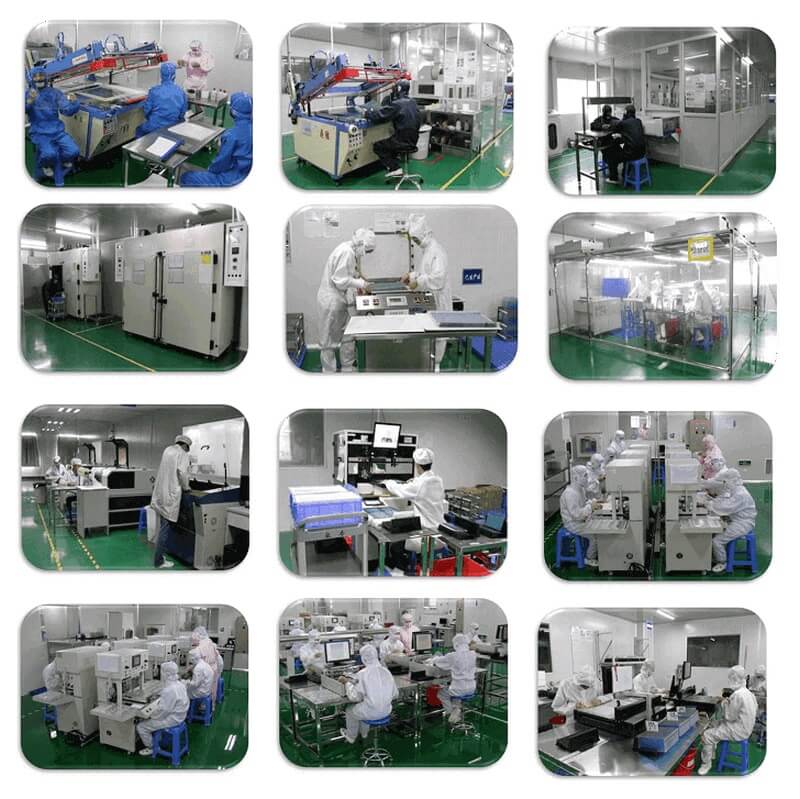
From early-stage prototypes to high-volume production, DINGTouch supports projects of various sizes with flexible manufacturing capabilities.
We offer:
- Fast prototype development
- Low-volume trial production
- Medium-volume manufacturing
- High-volume OEM production
- Long-term supply programs
- Engineering change support (ECO)
- Stable component sourcing
This scalable approach allows customers to move from concept validation to commercial deployment with a single manufacturing partner.
Industries We Serve
Our custom E-Skin and flexible pressure sensing solutions are used across a broad range of industries, including:
- Robotics and humanoid robots
- Medical devices
- Rehabilitation equipment
- Smart prosthetics
- Wearable electronics
- Industrial automation
- Human-machine interfaces (HMI)
- Smart home devices
- Consumer electronics
- Automotive interiors
- Service robots
- Educational robotics
- Sports technology
- Interactive retail systems
By tailoring sensor design to the specific demands of each application, we help customers improve usability, reliability, and product differentiation.
Why Global Customers Choose DINGTouch
Customers around the world rely on DINGTouch because we deliver more than individual components—we provide engineering-focused partnership throughout the product lifecycle.
Our key advantages include:
- Over a decade of experience in custom touch and display solutions
- Expertise in flexible pressure sensing technologies
- One-stop HMI integration capabilities
- Comprehensive OEM and ODM customization
- Rapid prototyping and engineering support
- Reliable quality management and validation processes
- Flexible production from low to high volumes
- Responsive technical communication
- Stable global supply chain support
- Long-term commitment to customer success
Whether you are developing a next-generation robotic gripper, a medical diagnostic device, or an intelligent industrial control system, DINGTouch is ready to help transform your concept into a reliable, production-ready solution.
Shenzhen Dingtouch Electronics Technology Co.Ltd.
Email:sales@szdingtouch.com
CATEGORIES
CONTACT US
Contact: Dingtouch
Phone: +8615815536116
Tel: +8615815536116
Email: sales@szdingtouch.com
Add: Building A, Bailu Plaza, No. 48, Gonghe Industrial Road, Gongle Community, Xixiang Street, Baoan District, Shenzhen,China. 518126
 Dingtouch