News
Who Can Still Hold the Line on Pricing During This IC Price Surge?
 Who Can Still Hold the Line on Pricing During This IC Price Surge?
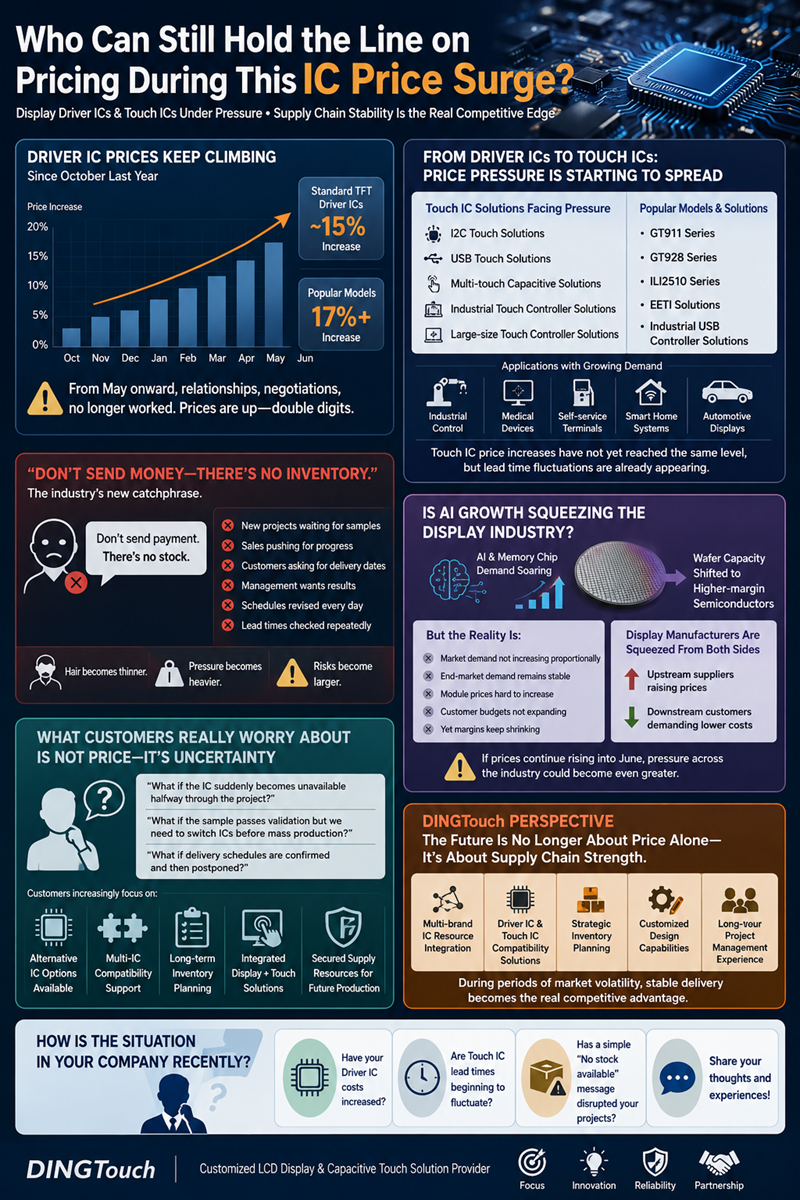
Since October last year, TFT Driver IC distributors have repeatedly announced price increase requests. Purchasing teams have done everything possible — multiple rounds of negotiations, inventory planning, early stock reservations, and supply chain coordination. Until before May, some orders could still maintain their original pricing.
To protect margins, management even joked that the purchasing team deserved a big celebratory dinner.
But once May arrived, the situation changed dramatically.
Relationships no longer mattered.
Negotiations no longer worked.
Everyone received the same message:
Prices are going up.
And not by a few percentage points either — we are talking about double-digit increases.
Standard TFT Driver IC have risen by around 15%, while popular models have climbed to 17% or even higher.
For the display industry, this is no longer just a cost adjustment. It is becoming a supply chain shock across the entire ecosystem.
From Driver IC to Touch IC: Price Pressure Is Starting to Spread
Previously, most companies focused mainly on TFT Driver IC.
But recently, more businesses have realized that the challenge extends beyond display drivers.
Touch controller IC are beginning to face pressure as well.
Examples include:
• I2C touch solutions
• USB touch solutions
• Multi-touch capacitive solutions
• Industrial touch controller solutions
• Large-size touch controller solutions
Popular models and solutions include:
- GT911 Series
- GT928 Series
- ILI2510 Series
- EETI Solutions
- Industrial USB Controller Solutions
As demand for multi-touch applications continues growing in industries such as:
- Industrial control
- Medical devices
- Self-service terminals
- Smart home systems
- Automotive displays
certain touch controller resources are gradually becoming tighter.
Although touch IC price increases have not yet reached the same level as TFT Driver ICs, fluctuations in supply lead times are already appearing.
For project-based customers, this often creates a larger problem than pricing itself.
Because the cost of project delays is usually much higher than the cost of an IC price increase.
“Don’t Send Money — There’s No Inventory”
Recently, one sentence from distributors has become an industry catchphrase:
“Don’t send payment. There’s no stock.”
It sounds almost like a joke.
But for project managers, it feels very real.
New projects are waiting for IC samples.
Sales teams are pushing for progress.
Customers are asking for delivery dates.
Management wants results.
Project managers are revising schedules every day.
Supply chain teams are repeatedly checking lead times.
Meanwhile:
Hair becomes thinner.
Pressure becomes heavier.
Risks become larger.
Is AI Growth Squeezing the Display Industry?
Another topic circulating across the industry is the rapid rise of AI and memory chip demand.
As AI infrastructure continues expanding, higher-margin semiconductor sectors are consuming increasing amounts of wafer capacity.
As a result, production resources for display driver ICs and touch controller ICs may be facing additional constraints.
If prices continue rising into June, pressure across the industry could become even greater.
The challenge is:
Market demand itself has not increased proportionally.
End-market demand remains relatively stable.
Module prices are difficult to raise.
Customer budgets are not expanding.
Yet margins continue shrinking.
Many display module manufacturers are now being squeezed from both directions:
Upstream suppliers are increasing prices.
Downstream customers are demanding lower costs.
What Customers Really Worry About Is Not Price — It's Uncertainty
Many customers can accept reasonable cost increases.
The real concern is uncertainty.
Questions such as:
"What if the IC suddenly becomes unavailable halfway through the project?"
"What if the sample passes validation but we need to switch ICs before mass production?"
"What if delivery schedules are confirmed and then postponed?"
For industrial equipment, medical systems, automotive products, and smart devices, supply stability is often more important than pricing itself.
As a result, customers increasingly focus on:
✔ Alternative IC options available
✔ Multi-IC compatibility support
✔ Long-term inventory planning
✔ Integrated display + touch solutions
✔ Secured supply resources for future production
DINGTouch Perspective: The Future Is No Longer About Price Alone — It’s About Supply Chain Strength
In the past, companies competed on specifications.
Today, they are competing on supply chain capabilities.
The companies that can maintain stable project delivery may not always be the ones offering the lowest price.
Instead, they are often those with:
✔ Multi-brand IC resource integration
✔ Driver IC and touch IC compatibility solutions
✔ Strategic inventory planning
✔ Customized design capabilities
✔ Long-term project management experience
Because during periods of market volatility, stable delivery becomes the real competitive advantage.
How is the situation in your company recently?
Have your Driver IC costs increased?
Are Touch IC lead times beginning to fluctuate?
Has a simple "No stock available" message disrupted your projects?
Feel free to share your thoughts and experiences.
DINGTouch | Customized LCD Display & Capacitive Touch Solution Provider
CATEGORIES
CONTACT US
Contact: Dingtouch
Phone: +8615815536116
Tel: +8615815536116
Email: sales@szdingtouch.com
Add: Building A, Bailu Plaza, No. 48, Gonghe Industrial Road, Gongle Community, Xixiang Street, Baoan District, Shenzhen,China. 518126
 Dingtouch